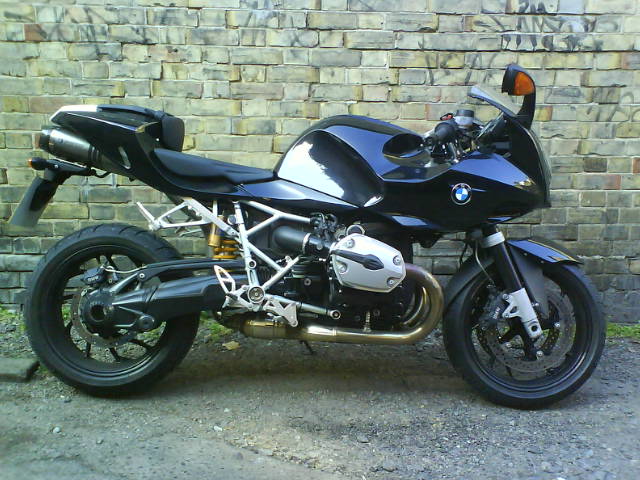
The BMW Lo Rider – sporty, purist roadster study with an individuallyvariable design.
Purist, powerful, unfaired and reduced to the absolute essentials – thesefew words provide an incomplete description of the BMW Lo Rider, the newconcept study by BMW Motorrad. At fi rst sight, the focus would seem to beon the creation of a roadster with a muscular appearance, openly displayedtechnology and powerful fl at twin engine for pure emotion and maximum motorcycling fun. But behind all this is in fact a completely new customconcept.
The bike’s low weight, the powerful and high-torque fl at twin engine andhigh-quality chassis technology give it a high level of sporty riding dynamics,while the lowered chassis and the relaxed yet active seating position with thebroad handlebars are more of a loan from cruisers and naked bikes.
The concept is such that, for the fi rst time, the customer can be involvedin the design of the BMW Lo Rider to an extent which goes beyond whathas previously been possible to date. Numerous options including differentexhaust systems, seats, headlamp units and paint fi nish variations allow fora level of customisation which is far greater than the familiar individualisationby means of special equipment features and accessories. This means thatthe entire character of the vehicle can be adapted to the customer’s individualtaste: the customer can take full pleasure in assembling a machine just as hewants it – from a cool cruiser to an aggressive muscle bike.
• Combines current technology with modern and classic stylistic elements.• Design elements can be individually combined by the customer.• Raised or lowered exhaust system, as preferred.• Seat for one or two as preferred, or aluminium perch seat.• Headlamp unit in classic shape or in streetfi ghter style, as preferred.• Fuel tank with or without aluminium trim, as preferred.• Four paint fi nishes for the fuel tank.• Three paint fi nishes for the engine casing.• Front and rear wheel wings fi nished either in black or chrome, as preferred.
An overview of the conceptual highlights.
Leading the way with concept studies – a BMW Motorrad tradition.
BMW Motorrad has a tradition of coming up with new ways and ideas when itcomes to motorcycling. Fascinating studies and designs have been producedin the past using ideas which then found their way into serial production.But studies by BMW Motorrad are about more than just trying to developa motorcycle which has not existed in a given form before. In addition tofunctions and quality, BMW developers focus on the emotional component –the connection between man and motorcycle. The guiding principle is thata motorcycle should not just function perfectly but should also appeal to allthe riders’ senses simultaneously, arouse an emotional response in him and fi llhim with enthusiasm at every moment – when stationary and when moving,as a whole and in its detail. In short: it has to light the fire.
Leading the way with concept studies – a BMW Motorrad tradition.
BMW Motorrad has a tradition of coming up with new ways and ideas when itcomes to motorcycling. Fascinating studies and designs have been producedin the past using ideas which then found their way into serial production.But studies by BMW Motorrad are about more than just trying to developa motorcycle which has not existed in a given form before. In addition tofunctions and quality, BMW developers focus on the emotional component –the connection between man and motorcycle. The guiding principle is thata motorcycle should not just function perfectly but should also appeal to allthe riders’ senses simultaneously, arouse an emotional response in him and fi llhim with enthusiasm at every moment – when stationary and when moving,as a whole and in its detail. In short: it has to light the fire.
Emotion through interaction – individualisation made-to-measure.With the BMW Lo Rider study presented at the EICMA in Milan, BMWMotorrad is not just demonstrating a continuation of this policy but is in facttaking a signifi cant step forward in focusing on the interaction between manand motorcycle. The idea is that for the fi rst time, the customer should beinteractively involved in the design of his BMW – going far beyond the familiaradding of special equipment features and accessories. The customer is to begiven the opportunity to be much more deeply involved in the design of theLo Rider from the outset, creating a customised, made-to-measure machinebased around the principal components such as engine and chassis.
Classic meets modern – a combination of stylistic elements fromdifferent eras.
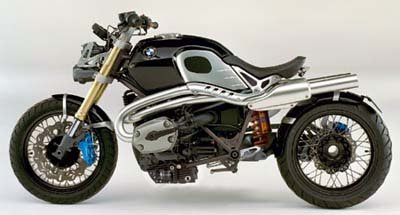
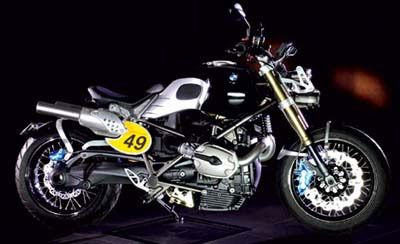
The study Lo Rider does not fi t into any of the classic motorcycle segments –and it is not supposed to. It combines the latest technical attributes of highperformance sports motorcycles with the traditional, classic principles ofmotorcycle construction. State-of-the-art chassis components from sportsmotorcycle construction such as the powerful upside-down fork, 6-pistonbrake calipers with real bite and wide 17-inch tyres are combined with styledefining elements of motorcycle construction from the fi fties and sixties. Forexample, with the exhaust system in a more traditional lower position in sidepipe style creates a classic roadster or cool cruiser look, while a raised exhaustsystem is reminiscent of legendary racing machines or typical scramblermodels of days gone by. Together with a range of variously designed seat.
The idea in detail.
concepts, also based on styles of the fi fties and sixties, as well as differingpaint fi nish versions, the BMW Lo Rider offers the motorcycle fan a wealthof possibilities by means of which to interpret the roadster theme in a highlyindividual way according to his own personal taste founded on a singlebasic motorcycle. In fact the Lo Rider gives the creativity of its rider almostcompletely free rein.
concepts, also based on styles of the fi fties and sixties, as well as differingpaint fi nish versions, the BMW Lo Rider offers the motorcycle fan a wealthof possibilities by means of which to interpret the roadster theme in a highlyindividual way according to his own personal taste founded on a singlebasic motorcycle. In fact the Lo Rider gives the creativity of its rider almostcompletely free rein.
Chassis and engine – state-of-the-art technology basedon classic principles.
The mixture of classic and modern stylistic elements of motorcycleconstruction combined with state-of-the-art technology is what gives theLo Rider its defi ning look from all angles. A torsionally stiff space frame ofsophisticated architecture openly displays the bike’s technology and togetherwith the upside-down telescopic fork at the front and Paralever rear-wheelswing arm provides the modern basis in terms of chassis technology - justas it is to be found in some current models of the BMW Boxer series. Whatis more, the chassis of the Lo Rider has been lowered as compared toconventional roadsters.
In terms of tyre dimensions, the 17-inch wheels represent the current state ofthe art for sports motorcycles, though with their chrome wire spokes, blackhubs and steel rims they ingeniously echo the characteristic stylistic elementsand fl air of a past era. By contrast, contemporary technology and a high levelof riding dynamics is provided by elements such as the high performance dualbrake disk with powerful 6-piston calipers, together with wave brake discsborrowed from motor racing at the front and the single disc brake at the rear.In terms of its engine, the Lo Rider also relies on technology which is bothcontemporary and full of character – the legendary, highly responsive BMWfl at twin “Boxer” engine. For 85 years, the construction principle of thisengine has stood for unmistakable, authentic design, a full torque curve andunique sound and power. In its current version with an output of over 100 bhp,overhead camshafts, electronic fuel injection and exhaust gas purifi cation, thepowerful response of this dynamic and distinctive 2-cylinder is simply perfectfor the BMW Lo Rider.
The customer as designer – individual designs and paint fi nishes.The concept study Lo Rider is mainly focused on the two essentialcomponent groups of a motorcycle, the engine and the chassis. Anysuperfl uous decoration is omitted. Instead, variable components such as theexhaust system, seat, headlamp unit and paint fi nishes determine thebike’s outward appearance, at the same time defi ning its conceptual style.
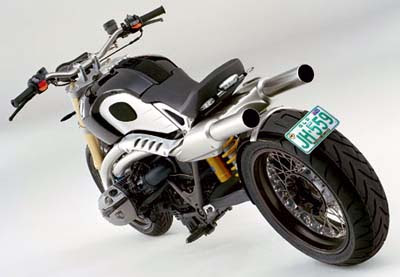
The combination of these classic and modern components is entirely subjectto the personal taste of the customer. For example, he can initially expressthe dominating character of the BMW Lo Rider through the placement of theexhaust system, creating either a sporty style or opting for a more roadsterlikelook by having it lowered.
A very sporty effect is created by the classic perch seat made of aluminiumsheet metal, while the simple single seat reduced to the absolute minimumwill appeal to purist motorcycle fans. The single seat can also be optionallyextended to include a pillion passenger module.
The specifi cation laid down for the development team led by David Robb,Head of Design Development at BMW Motorrad, was that all the conceivablecombination options of these components should produce different endresults but that the bike should always retain a rounded, coherent characterin itself. Whether with a raised or lowered exhaust system, with sporty perchseat or seat bench for one or two people: the Lo Rider comes over differentlyevery time but always makes an impression.
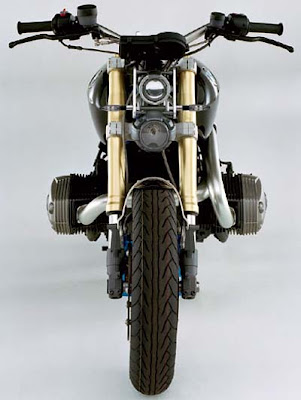
The same applies to the selection options in creating the front section of theLo Rider. With their aggressive, modern design, the vertically arranged dualheadlamps give it a touch of the streetfi ghter, while the classic, semicircularheadlamp provides an echo of past times. Once again, the same principleapplies: however different the styles thus created might be, they always havea consistent emotional appeal for the rider.
Further possibilities for individual design are available to the customer in thechoice of paint fi nish. There are four different colours available for the fueltank, and with the three different paint fi nishes for the engine casing thisallows the customer to create a very distinctive, personal look, defi ning thecharacter of the Lo Rider as anything from refi ned to sporty. These alwaysharmonise perfectly with the deliberately classic, high-quality aluminium partssuch as fuel tank trim, seat holder and wing struts. Different styles can alsobe created with the front and rear wings which are available either in black orchrome fi nish.
Finally, another element which harmonises perfectly with the overall conceptof the Lo Rider is the individually adaptable range of rider equipment. Thisincludes classic leather jackets, protector jeans, boots, gloves and authenticjet and integral helmets. This ensures that not only the appearance of the LoRider is perfect but that the rider has just the right look, too.







 PR:
PR:  LD:
LD:  I:
I:  Rank:
Rank:  C:
C: 


